A local interface for the exploration and analysis of large connectomics datasets
Author
Oskar Żółciński
SWPS University
Project Description
Modern connectomics increasingly involves massive, open-source datasets at the peta scale and the automated segmentation is inescapably imperfect, requiring manual corrections. Proofreading such volumes of data necessitates simultaneous collaboration of dozens of researchers via tools such as the Connectome Annotation Versioning Engine (CAVE) which, along with proofreading functionality, provides programmatic access to structured repositories of proofread cells suitable for analysis. These repositories are cloud-based, and access to individual datasets is scattered across the web (codex.flywire.ai, microns-explorer.org, bossdb.org/projects, etc.).
This project aims to create a local python interface that will provide user friendly access to all datasets that are being collaborated upon under the CAVE infrastructure. A web-based version which would be better optimized for certain use cases might also be considered in the future.
The development process will involve the following:
– Cloud data access and download workflows
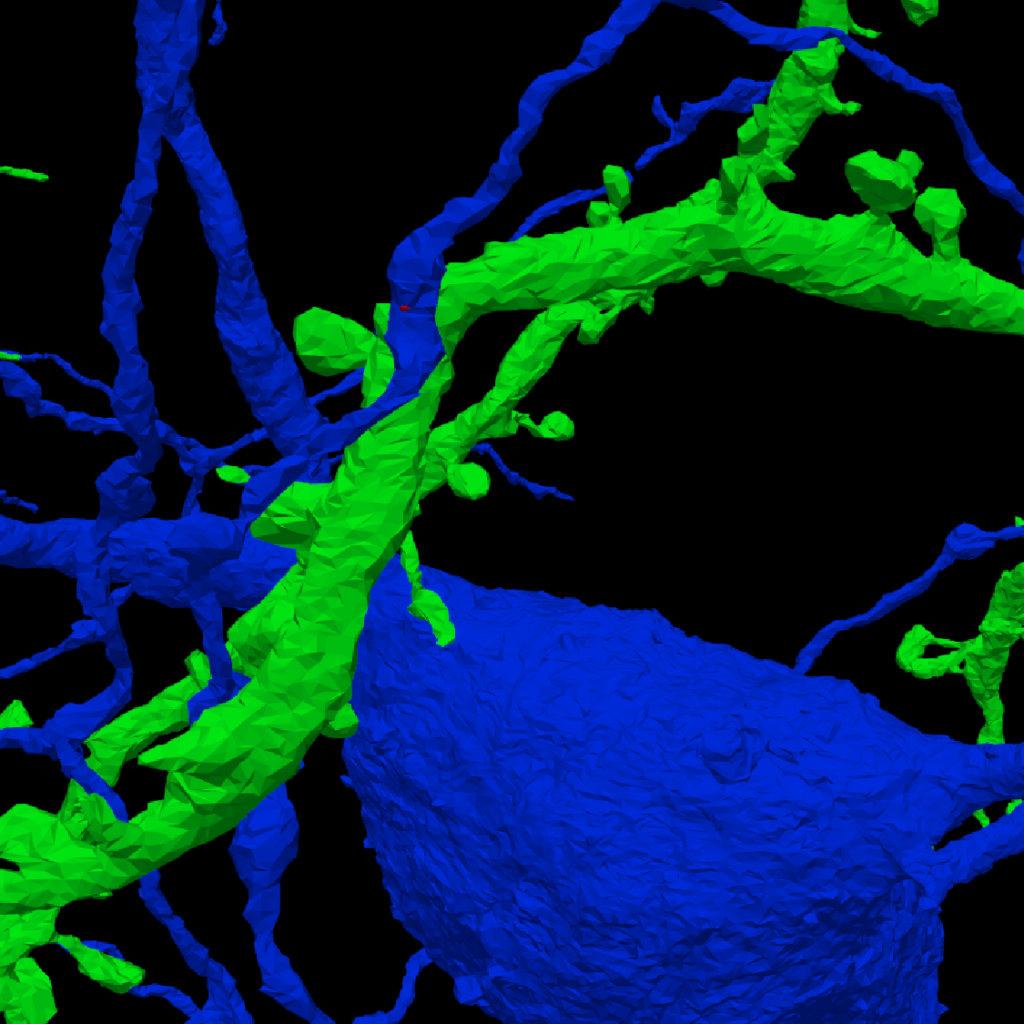
– 3D mesh data handling workflows
– UI and visualization design
– Cell typing and morphological analyses
Python libraries that will be used include but are not limited to: PyQt, PyVista, CAVEclient, cloud-volume, MeshParty/Trimesh, Numpy, Pandas, json
Project requirements
Education level: any academic degree (or student if other requirements met)
English level: proficient
Other requirements:
- Experience with handling and visualization of three dimensional mesh data in python (libraries such as meshparty, trimesh, pyvista)
- Experience working with cloud service dataframes
- Basic understanding of connectomics and state of the art reconstruction workflows
Optional but welcomed skills:
- UI design in Python (PyQt)
- Deep learning and neural networks expertise
- Background in neurobiology
Programming languages used in this project
Python
Who are we looking for?
Participation of one to two neurobiologists (neuron morphology and classification) and one 3D artist (Blender) would be very welcome and worthwhile.
Neurobiologist(s): morphological analysis and classification of neurons will be an important part of the project. Before cell visualization, morphological cell typing will serve as one of the main ways of navigating large open source connectomes. For this reason, expertise in this domain will be of high utility during the development of the tool.
3D artist: while not a fundamental part of the project itself, Blender visualizations and animations of real life neuron reconstructions are a uniquely appealing and creative use case for such 3D models. Since both 3D model and meta data files will be stored locally, they can be easily imported into Blender directly from the working directory. Examples of such work can be seen in the form of renders on the MICrONS Consortium website – https://www.microns-explorer.org/gallery-mm3-renders.
What can you gain from participating?
Modern connectomics often requires the collaboration of dozens of researchers (hence the MICrONS & FlyWire consortia) with different backgrounds and expertise. The hope is that participants will gain experience working in a relatively large team consisting of multiple subgroups focused on different aspects of the project, such as morphological cell typing, open data access & handling and interface functionality.
Perhaps the most valuable benefit for the participants will be the networking potential of this endeavour. There is relatively little community around connectomics in Poland and such an opportunity for collaboration could potentially spark new cutting edge research. And lastly, … is that together the team will build something that wouldn’t have been possible to accomplish alone.
Key resources
- The MICrONS Consortium. Functional connectomics spanning multiple areas of mouse visual cortex. Nature 640, 435–447 (2025). https://doi.org/10.1038/s41586-025-08790-w
- Dorkenwald, S., Matsliah, A., Sterling, A.R. et al. Neuronal wiring diagram of an adult brain. Nature 634, 124–138 (2024). https://doi.org/10.1038/s41586-024-07558-y
- Dorkenwald, S., Schneider-Mizell, C.M., Brittain, D. et al. CAVE: Connectome Annotation Versioning Engine. Nat Methods 22, 1112–1120 (2025). https://doi.org/10.1038/s41592-024-02426-z
- https://www.microns-explorer.org/
- https://codex.flywire.ai/